Wednesday, March 7, 2018

Discussing adoption with the New York Times #RaceNYT

It's been far too long since I've posted on my blog! I'm thinking about migrating to my own domain, but until that happens I have some awesome news: I'm going to be discussing adoption, race, and identity with The New York Times for their weekly #RaceNYT Facebook Live chat tonight!
My sincerest thanks to the person who shared the NYT submission form for adoption stories back in December on Facebook—I was chosen out of dozens and dozens of submissions. Obviously I’m feeling excited and honored, but also nervous about carrying the weight of representing Chinese adoptees to a global audience of hundreds, potentially thousands. Though I can only speak to my own story, I told reporter Rachel Swarns that being part of the China's Children International Facebook group has provided instrumental support in the last few months. 
To stream the chat, visit https://www.facebook.com/nytimes at 9:00 pm EST and open the live video. 
If you're on Twitter, join the conversation with the hashtag #RaceNYT and hit me up @Nicolewhaat (click for the link)! You can also contribute and share your input with reporter Rachel Swarns on Twitter here.
I'm so proud for this opportunity to share my adoptee story and amplify our complex, diverse, and growing community. Thanks for your support, and see you online tonight!

Wednesday, November 16, 2016

Why I'm Reclaiming My Asian Racial Identity in Trump's America

This article was originally posted here on Weave News, an independent media organization dedicated to investigating underreported stories, highlighting alternative perspectives, and promoting grassroots media-making and critical media literacy. Please consider making a monetary gift to sustain this global community of citizen journalists. To learn more, visit WeaveNews.org.

---
Why I'm Reclaiming My Asian Racial Identity in Trump's America

In the past week, people who identify as Women, Muslims, Disabled, LGBTQ+, Immigrants, Black, Asian, Latinx, and anyone else in between have faced a startling rise in hate threats, visual statements, and actual assault. Insanul Ahmed, a Brooklyn-based music editor, collected an ongoing Twitter list of racist accounts towards people of color in the first day following the election. The Southern Poverty Law Center launched a #ReportHate portal for citizens and witnesses to submit incidences of hateful harassment and intimidation. As of November 11, over 200 incidences were directly reported. That number is bound to rise. Not that these threats didn’t exist before, but the reactionary nature and hyper-visibility of these recent incidents are directly tied to the election of Trump.
Image source: http://nextshark.com/asian-americans-now-targeted-harassment-donald-trumps-victory/

I feel generally secure living in Massachusetts, the only state other than Hawaii in which every county voted Democrat. It’s a predominantly white, liberal, and progressive community. Yet as an Asian woman, I have remain on guard. As a transracial adoptee, I didn’t always consider race at the forefront of my identity.

My premise for writing this blog series, Adopted Identities, was that transracial adoptees--generally children of color raised in white families--are caught in between races, and thus, caught in between worlds. Being raised in a predominantly white family and community. Being socialized with the norms of white privilege. You know how to operate in a white world… but you’re still not white. Your non-white physical features will never allow you to be white. You don’t relate socially and culturally with the race society defines you as. You don’t even feel comfortable taking the role of “token [race] friend” because you feel similar to the white people around you, but you have to accept it.

As a transracial Asian adoptee, I don’t fear and experience the constant threat of prejudice and discrimination because I live in the halo of whiteness. From how I was raised, to where I went to school, to my current location--generally speaking, 90% of my interactions are with white people. It is a level of comfort I was socialized into. I was the only Asian person, the only Chinese, I knew in rural, western New York. I didn’t know what being “fresh off the boat” was, or harbor any intergenerational guilt to follow a cultural set of values and language, as many first- and second-generation children of Asian immigrants experience.

For many years, I accepted this racial blindness just like the rest of my social circle. I was just another white friend who looked Chinese. I was unwilling to check the “Asian/Asian Americans” demographics box. Being hesitatant to engage with Asian activists because I don’t feel “Asian enough.” I was called a “chink” once to my face in high school. Racist encounters, to my relief, seemed rare and localized. Until now. In the United States, you cannot be blind to your race. In Trump’s America, your safety and security may depend on it.

You don’t see me the way I see me, and this makes me a target. If you just saw me on the street, you would likely assume I’m “another” Chinese person. Maybe I work at one of the local Asian restaurants. Maybe I’m an exchange student learning about American culture. Maybe I know that Vietnamese woman you talk to once at a bar because, oh, that’s in Asia right (this has happened to me)? And maybe, you hate me because I’m stealing your jobs and your livelihood.

In Trump’s America, I can no longer be racially colorblind--nor allow others to regard me that way. I’m claiming my Asian identity. With this, I will use my in-between privilege of identity to influence white communities. People that know me may hardly consider that I’m Asian due to that white halo, and I will use that avenue to start conversations. I will not claim experiences that aren’t mine, but I will amplify those that may not reach white eyes and ears otherwise. We need to protect and denounce hate towards the most vulnerable now, more than ever.

My ask to you: please do not tell me what to feel about Trump’s America. Do not tell me, or anyone whose identity intersects with one of the above, that it’s going to be okay. Do not tell me Trump’s hate speech was “just talk” for the election. Tuesday, November 8 the United States of America chose its leader of whiteness, sexism, misogyny, racism, ableism, and bigotry: Donald Trump. Do not shrug this statement off as hyperbole.  He has stoked the 240 year-old flame of institutional oppression. He has encouraged and emboldened intimidation and violence towards people who may not be able to protect themselves.

In Trump’s America, this may be the greatest threat that I and other adoptees face: you don’t see me the way I see me. But I will use this as a strength. When I talk about fear, it’s real. My halo of whiteness won’t protect me from those who don’t know me. I need your support, as do millions of others. So my most important ask to you is: please listen, and don’t dismiss me as just another white friend.

Tuesday, June 28, 2016

Local Grazing

It's full-fledged summer here in the Berkshires, and I'm doing the best to live each day as its own, resisting the urge to mindlessly move towards the weekend. Living on a lake has been such a privilege. I can savor the water, be it watching the sun move across the sky, kayaking and canoeing, practicing yoga, lounging, or even swimming. The depth off the dock is just about chest height for me, with clear water that's algae-free due to its own variety of herbicides, but otherwise the perfect temperature.


This year I wasn't as ambitious with my garden plantings, but I decided to fill the patio garden box with lettuces. The garden bed attached to my neighbor's home has dinosaur kale, bok choi, zucchini, a few tomatoes in serious need of cages to keep them upright, and hopefully beautiful rows of sunflowers. In the kitchen window there are basil and parsley plants growing in pots.The greens are absolutely thriving in this full sun and semi-frequent rains. I've actually reached a critical mass with lettuce, and find myself passing it along to friends and neighbors before it grows to tall and bitter. It is certainly the most gratifying vegetable I've grown yet, and the best part is its low maintenance and resilience. Less than 4 weeks after the first planting in a bed of manure-based fertilized compost (redundant, I know), the little leaves are bursting spirals of greens, yellows, purples, and reds, that can be plucked from the outside-in, or cut at the base for a full head. I relish in making a salad any time of day that was grown a few feet from my door.

As you may remember, I strive to keep my food purchases and consumption as local as possible--a locavore, if you will. In a polarized global economy where most supermarket produce has traveled thousands of miles for several weeks out of its indigenous season after being drowned in pesticides on an industrial farm that's indentured to the patents of its corporate parent seeds and utilizing underpaid migrant labor in hazardous conditions, well... you should be able to see why where your food comes from matters. Don't even get me started on meat. My heart squeezes in a terrible way when I think of the more than 450,000 concentrated animal feeding operations (CAFOs) where cattle and poultry are trapped to a life of confinement, stuffed with corn, then slaughtered à la Upton Sinclar's The Jungle to become our $3 burger, also while exhausting water resources and producing methane gases. No, I'm not a vegetarian, nor a a devout PETA supporter; I simply believe in giving all creatures a life of dignity.

It's easy to assume that local, "natural" stores and markets are too much for your wallet. So, I challenge you to take a 1-2 week inventory of what you actually completely eat in your household. I'd make a bet that most of you waste at least 40% of what you've purchased, because it degrades too soon (also a symptom of industrial, far-traveled produce), the expiration dates are mislabeled, or you just don't feel like being reinventive using leftovers for new meals. I'm not blaming you; it happens. Maybe you went out for dinner more often than originally planned, or realized that no matter how hard you try, Brussels sprouts are gross in any form (not true for me~!). Those food stuffs in the garbage, though, add up as lost dollars and needless space in our garbage dumps, when it potentially could have been purchased by another family, rescued by gleaners, or donated to a community kitchen. I was really proud to be part of these efforts with the Campus Kitchens Project at St. Lawrence University.

While the prices at small-owned stores may be more expensive, you should inquire a bit further. Usually the products sold at organic shops and co-ops are from companies with equitable, sustainable sourcing and production processes. Think: fair wages for farmers in developing nations, no genetically-modified (GMO) plants, recycled packaging, a community-owned business model, and so on. At the store itself, these employees tend to be have a better living wage and working environment. This sounds like a pain the ass to do all this investigation, because unfortunately, marketers understand how to label, package, and brand deceitfully. We're all at risk here, but have the ability to be conscientious consumers and hold the food industry accountable. In our capitalistic society, dollars matter. The extra effort and overhead is an investment into your local economy. You'll buy a bit less, waste less, and enjoy it more.

Farmers markets proliferate New England this time of year in the open air, where children and pets can wander to produce, dairy, meat, coffee, jewelry, craft stands, all things imaginable, away from harsh supermarket lights and heavy crowds. Some cities have bustling markets, yet the shoppers tend to be relaxed and friendlier. It's great if you know in advance which farmer's will be there and zip in and out with your purchases, but it's also wonderful to stroll through for the holistic, sensory experience. Many towns are even holding winter farmer's markets so you can support your local producers year round.

I must give a shout out to the Downtown Pittsfield Farmers Market, whose wildly successful Double Value program has truly made the market economically equitable (say that five times fast). The Double Value Program is a money-matching program available to mothers, senior citizens and low-income residents who are using their SNAP, WIC, and Senior Farmers Market Nutrition Program benefits. According to their website, the program’s reach far surpassed the market’s projections and in just thirteen weeks during the summer 2015 launch, putting over $20,000 worth of fresh food on the tables of families in need and leveraged federal SNAP dollars to support local farms and the Berkshire economy. As a personal antidote, I took advantage of this program when I was still an AmeriCorps VISTA receiving SNAP benefits. My food budget was limited to those dollars each month, yet this market afforded me twice as much incredible, local food. I'm so thankful for the visionary directors of the market, and the businesses that fund this venture.

At the farmers market, you can taste the difference. Your luscious, heirloom, tomatoes will remind you why it's worth the 11 month wait between seasons. Strike up a conversation with producers. Don't be afraid to ask questions; they want to share their bounty and labor of love. They will teach you so much more about nutrition and this world than a sticker ever will. The relationships that blossom will make you feel more connected and in touch with your community, while eating with a conscious. If you're not sure where to go, the USDA has a market locator that even filters the types of products available and accepted payments.

I can't wait for Saturday morning, the next downtown farmers market! And ifyou're in the area, please stop by so I can give you some greens.

Monday, June 13, 2016

We Need to End Rape Culture

I post a lot of my immediate reactions to current events on facebook, neglecting my dear blog that's been such a vessel of thought processes--well here you go. This is case is very important, but this is a trigger warning to anyone who has connections to assault.

I imagine most of you have heard of the Stanford rape case that's all over the media, particularly the minimal, 6 month sentence the rapist is receiving. According to the judge, a longer sentence would have "a severe impact on him", failing to recognize the victim's irrevocably damaged life.


I printed the victim's letter of impact (via Buzzfeed) last week to sit down and seriously hear this woman's courageous voice. I needed a few days to fully digest it, and I ask you to do the same. I wish I could thank her for refusing to be silenced as a survivor, and not accepting the rapist's pathetic excuses.


1 out of every 6 American women has been the victim of an attempted or completed rape in her lifetime. Think if this victim was your daughter, sister, best friend, neighbor, or just a woman you see everyday. Chances are, she's already experienced violence in her life in some form. But it's not just women; every 2 minutes an American is sexually assaulted, encompassing all genders and races.

I hope reading her statement makes you uncomfortable. Sad. Angry. Willing to educate yourself and act on those around you. We need to stop rape culture, and this means stopping the insidious comments, images, and acts that excuse and promote violence--and the policies and legislators that are guided by misogyny. I don't have many answers, but I know there are plenty of amazing organizations and people working on this. If you're interested in learning more statistics on sexual violence, I visited https://rainn.org/statistics/victims-sexual-violence.


Saturday, November 14, 2015

Considering Humanity and Representation

I had the incredible privilege to visit France on three different occasions, beginning in high school exchanges with Lycée Bréquigny in Rennes, in northwestern France (Bretagne). The host students and their families, friends that became pivotal to how I regarded the world revealed that our (U.S.) culture, ideology, and mannerisms are different. Yet I also came to realize that at the end of the day, we all desire the same thing: love, liberty, security, connection, and heck, if success came along with that, even better. Travelling opened those doors for my mind and soul. After three cycles of exchange students, I knew I would return to France

In August 2011, my sophomore year at St. Lawrence University, I embarked on a semester-long life in Normandy, the north-central province of France. Rouen was only an hour north of Paris by train. New families and faces and landscapes, each peeling back another layer of humanity. The full-throttle immersion was not always easy, and honestly I probably gained 10-15 pounds from stress-induced eating. In France that meant flaky, full-fat buttered croissants and luscious Belgian chocolate. I spent most of my time travelling the country, rather than hopping around Europe, because there were so many regions and histories to discover. I'm likely among the millions, perhaps billions, of people who can say that they hold Paris "close to their heart." My program spent a full week there, hilariously at the same hostel we stayed at when I was in 10th grade. That was my third visit to Paris, and each day I was still visiting new awe-inspiring sites and secrets.


Over time, France and its people lost a bit of glimmer for me. The aggressive politics of xenophobia, racism, and nativism rubbed me to defense-mode. It was easier to argue and blame me about U.S. neoimperialism and conservatism, than it was to speculate about the context in which it developed. Those interactions were never fun, but that's the trade-off I took for being a U.S. citizen. And honestly, Parisians can suck. Other non-Parisian French even agreed. If you weren't from Paris, they made sure to remind you with a heavy dose of egocentric snobbery. So, we're all human. And by no means perfect.

Although my gilded image of France chipped away by the end of my semester, I was indelibly thankful for the experience. I was transformed and ready to take on more. I think because of those compounded months of intense human experiences, I developed a more dynamic lens through which I could view the world. Travelling isn't the only way to hone these sorts of revelations, but it was for me.

So what's my point? There will always be part of me connected to France. By connecting with another culture despite language barriers and cultural difference, I felt (feel) more connected to humanity. Humans are complex, socialized, historicized creatures, situated into cultures and perspectives they have no control over. I actually love exploring that notion.


Humans can also be cruel. You can check out from the internet and radio for a few hours, and suddenly the world has flipped. I had caught a brief clip on the radio when the Paris attacks began, but it wasn't until this morning that I learned of the enormity. My mind is reeling, the more I learn. I'm so relieved that my Rouen host sister, who lives in Paris, is safe.

Through my punctuated grief and washes of pain for France, I can't help but feel guilty about my reaction, too. I think this crisis and the media spectacle has exposed the enormous deficit in the way we understand the world. For the most part, our lens of understanding is dominated and directed by corporate media, and instantly consumed.

What did I say earlier? "...and suddenly the world has flipped." Because I'm a U.S. citizen, "the world" equates to whom we most relate: U.S. military powers of the Global North, such as France. They are our partners, so similar to our ideals and what we stand for; liberté, égalité, franternité. The attackers were obviously individually motivated, but it is imperative that we don't forget the historical circumstances that lead them to this destruction. 'Terrorism' is too easy of an excuse, and a cop out. Recall: humanity is complicated. Was France possibly complicit in its own disaster? How deeply are we examining the rise of the Islamic State and extremism?

The unfortunate reality is that France holds greater proximity, and thereby priority, to me than Beirut. Than Syria. Than the Congo. Violence like this is happening every fucking day, and now I'm finally reacting (aside from the occasional-but-increasingly-frequent conversations to commiserate with my friends). The world is reacting with more for France because I've been told -- we've been told -- to do so. It terrifies and disgusts me that we are normalized to the violence in other parts of the world that aren't a national priority. 

By no means am I saying that anyone in Paris, France, or the rest of the world deserved this horror. But before we begin aiming our guns and hatred, don't forget what we -- the United States, France, the Global North or dare I say, Western Imperialists --  have done to others. Our drones drop bombs on villages in Pakistan every day. We've tortured and slaughtered thousands of Iraqis as mere suspects of terrorism, whether they were complicit or not. Thousands of refugees have sacrificed absolutely everything they know to escape hell, seeking refuge in Europe and the U.S., and we refuse to open our doors widely. Where was the safe button for Beirut, bombed two days ago? Where IS the safe button for Palestinians? These people have lives, families, histories, and dreams that simply aren't acknowledged. They are portrayed as the 'Other': static, unchangeable, voiceless, inherently unrelateable. That's reflected in simplistic answers, and blanketed assumptions. We aren't granting all people the human complexity they deserve.

What I'm asking is to make sure you take a moment to lift the blinds on your lens. Say a prayer, send your thoughts, post your hashtags for France. Because Paris, je t'aime. I really do. But please take a moment to remember others suffering in this world. Don't ever let violence be normal. I need to remind myself this more often.


There's one last piece to my brain vomit: perhaps my guilt is misplaced. I do have tangible and psychological connections with France, so it makes sense that I would be rattled. However, as humans, what is the threshold for empathy? How much information can we actually process?Technology has allowed this endless barrage of news and sensationalism to flood our minds, so is it possible to care about everyone and everything all the time? I can't believe that it is. I think I just despise how easily our minds are interpellated to care about some more than others.

I'm not trying to be self-congratulatory. Just trying to reflect critically on what's happening, and where we go from here.

All photos my own, taken in Paris in late October 2011.

Thursday, September 24, 2015

Westward Bound!

Business at work and a lack of wifi has resulted in a distinct lack of blogging, but I just had to share these pictures from the wild, wild west! I visited one of my best friends, Brad, in Colorado and we also ventured to Wyoming from September 12-19. This was my vacation to celebrate the end of my AmeriCorps VISTA term, and subsequent hiring onto the Central Berkshire Habitat team.
Feast your eyes on the glorious Rockies!

The town of Dillon hosted weekly concerts on the reservoir (that serves Denver) during the summer. We caught the last one the night I flew in, featuring a Michael Jackson funky tribute band!
The towns are high in the mountains, 8,000-9,000 feet in elevation, and built largely around the ski resorts. They ski lifts still operate in the off-season, so we hiked around Keystone Mountain.
View of Dillon Reservoir and surrounding towns from Keystone Mountain.
Climbing a rock slide at Copper Mountain.

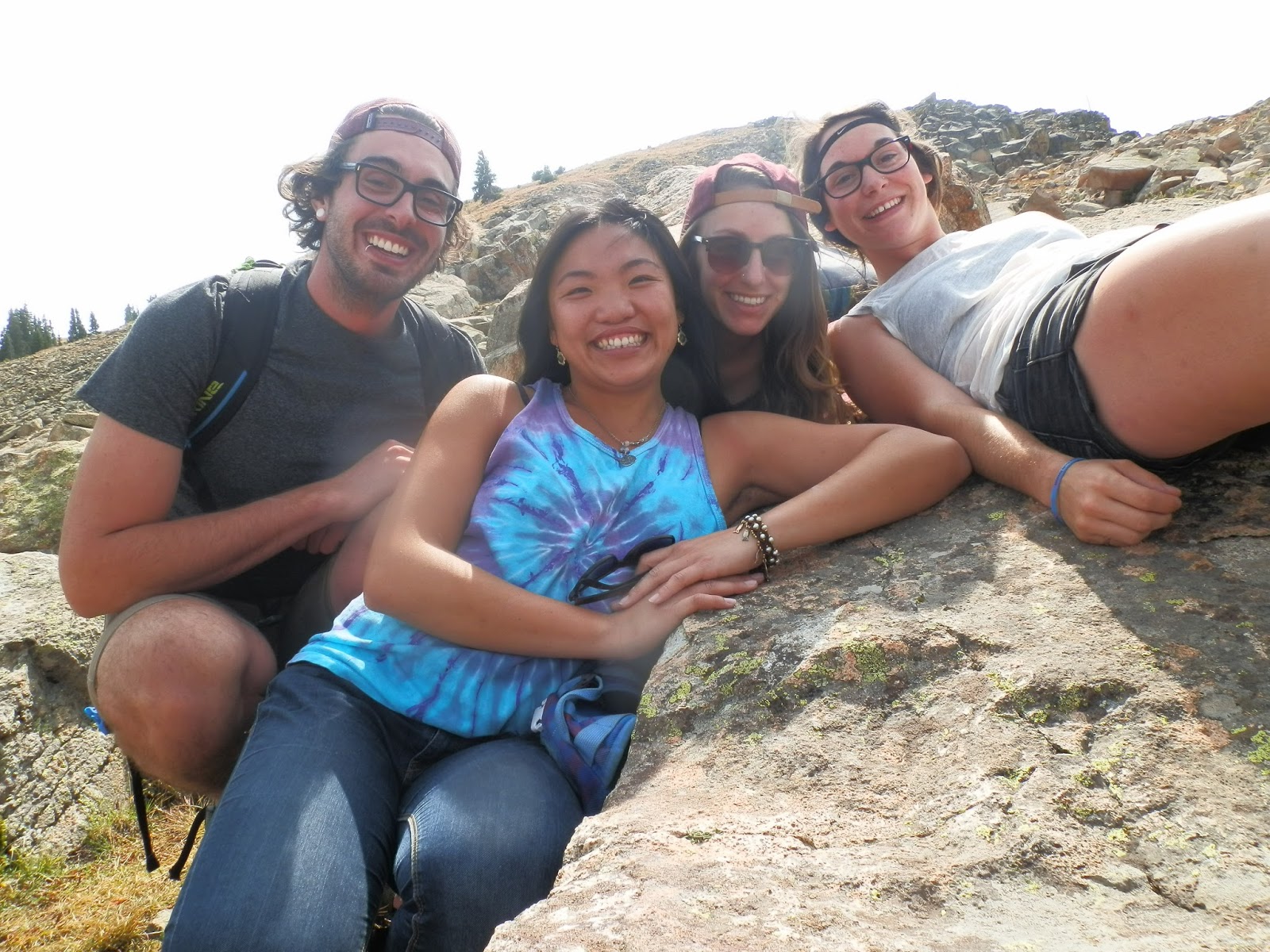
The neat part about Dillon, CO is that there are a few other friends from Honeoye that have moved out there! We met up with Nikki and Bri who hiked around, and also joined us on the Wyoming road trip.
The view from Copper Mountain was a bit hazy from wild fire smoke blowing in from farther west.
We drove 8 hours north through the vast lands of Wyoming, to Jackson Hole where I was able to meet with one of my friends from Habitat/St. Lawrence (photo on Facebook), and then to Grand Teton National Park!
Proud to say that I was the first one to spot this moose, then cause subsequent traffic jams.
He was a beaut!
Despite the freezing rain, we convinced ourselves that it was worth taking a swim in Jackson Lake at the base of the Tetons (which were shrouded by the fog). We figured the lake would be warmer than the air -- and we were wrong! Photo is post-swim.
Not too long after the dip, we made it to Yellowstone! 

Every 10 minutes is a different, jaw-dropping geography.
We snagged a camp site before they all filled, which had full running water (thank goodness).

Wyoming sits upon a volcanic caldera, and is so alive through its hot springs and geysers.


The sulfuric gas stinks, but the hot springs are beautiful! Don't even try touching them, though... they can be as hot as 300 degrees F. 

Here's Old Faithful, but it erupted once it was too dark for a photo. The lodge there is gorgeous, but I'm glad we arrived when things were closing up.

The bison were incredibly majestic! The locals actually refer to the calves as "red dogs" because they are born this color until they turn darker brown. 
The best traffic jam I've ever been in (and would prefer)!
Elk interspersed at another tourist stop.

Calcite springs tumbling into the Yellowstone River.
Amazing vistas, and snow falling on the 14,000+ foot peaks in the distance (no thanks!!).
Lower falls in Yellowstone Canyon is one of the park's best known views, although the number of tourists there was overwhelming. 

Our crew at Yellowstone Canyon.
And then we saw a grizzly!! All these cars were stopped and the rangers were trying to redirect people to the cars (duh), yet I was thrilled at the opportunity to spot one. 
On the way back out of the park, the Tetons revealed themselves to be dusted with snow!
Back on the shores of Jackson Lake (but not for a swim)!
Wyoming was a dream. I would love to go back!
I still had a few days in Colorado after that, so I hiked among the gorgeous golden aspens and Mount Buffalo (the hump in the distance).
We did a quick hike at Mont Royal, which gave more beautiful views of Summit County.
On my final full day, we drove 3 hours south to the Great Sand Dunes National Park! This 30-square mile monument formed after a millennium of erosion and sediment deposits, tucked between the mountains.

Truly epic and surreal. ... then we hiked.
There was a class sand boarding down one of the first dunes!

It took us a while, but we ascended the highest dune in North America, rising 755 feet over this micro-desert!
More sand boarding... ouch!
On our way back down, the wind picked up so I went into storm trooper mode to protect my face. We weren't at the Great Sand Dunes for too long, but it was simply another marvel of nature I visited out west.
The West was amazing, the vacation very restorative, and I really enjoyed spending time with Brad, who's been with me through middle and high school and crashed his car on the way to St. Lawrence (and the only hometown friend to visit me) senior year. Quite the reunion.

(I can't guarantee more blogging in the immediate future, though hopefully these photos suffice!)